

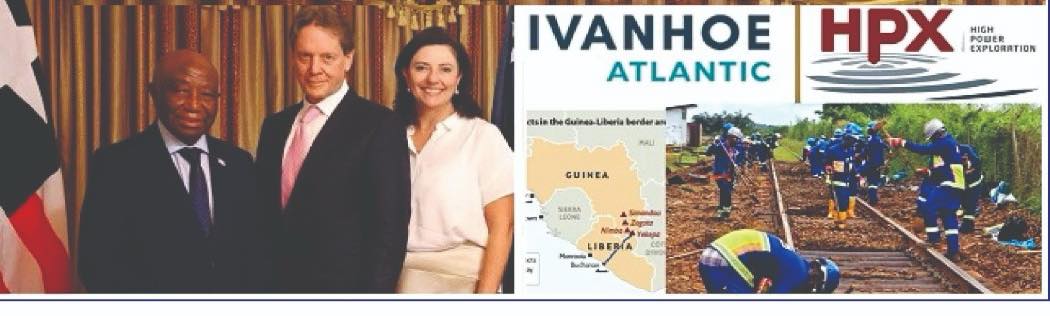
On July 5, 2025, the Government of Liberia signed a 25-year Concession and Access Agreement (CAA) with Ivanhoe Liberia (HPX/SMFG), granting major rail and port rights along the Yekepa–Buchanan corridor, and transmitted it to the Legislature for ratification. Public information around the deal is sparse and evolving, yet what is known, together with particularly concerning provisions inside the Agreement, raises red flags about sovereignty, economics, and the absence of clear Guinean consent for cross-border shipments.
Liberia’s own press materials acknowledge the CAA’s operation is “contingent upon necessary bilateral arrangements with the Government of Guinea.” In plain terms, HPX/SMFG cannot export Guinean ore through Liberia without Guinea’s formal assent—yet no such assent has been publicly produced. Proceeding to ratify before that consent hardens in writing risks locking Liberia into obligations while the critical precondition remains uncertain.
The CAA’s structure grants Ivanhoe Liberia and affiliates expansive Track Access Rights, Train Service Entitlements, and Port Access, anchored by minimum payments and indexation formulas. It also embeds heavy investor-protection machinery—confidentiality, broad transfer/change-of-control permissions, termination payments, and international arbitration—that can shift commercial and political risk onto the Liberian state if the project stalls or terms prove unfavorable. Key areas of concern include:
- Long Tenor & Broad Rights: The Agreement spans 25 years and centers on rail/port access up to very high volumes (official communications cite up to 30 mtpa). Such breadth, once coupled with minimum payment and indexation mechanics, can crowd out national flexibility if macro or regional conditions change.
- Minimum Annual Transit & Access Fees (Section 19): Guarantee-like fee floors backed by indexation can create de facto state liabilities if throughput lags due to market swings, supply disruptions in Guinea, or regulatory delays, turning a “user pays” model into a potential fiscal burden.
- Termination & “Company Termination Payment” (Section 26): The CAA’s termination architecture, including a Government Termination Payment and Company Termination for Convenience, may obligate Liberia to compensate or assume assets on unfavorable terms, especially if the project underperforms or cross-border approvals fail to materialize.
- Transfers, Assignments, and Changes of Control (Section 24): Latitude for affiliate transfers, encumbrances, and changes of control increases the risk that Liberia negotiates with one party today but faces a different, potentially less accountable owner tomorrow—without meaningful public oversight.
- Confidentiality (Section 23) and Five-Year Review (Section 35): Sweeping confidentiality coupled with infrequent periodic review diminishes transparency and limits Liberia’s ability to recalibrate terms if circumstances or public interest demands change sooner.
- Arbitration & Sovereign Exposure (Sections 28, 34): International arbitration paired with sovereign immunity waivers is standard in project finance, but combined here with robust fee/termination constructs, it heightens Liberia’s downside if disputes arise.
Reports and commentary have suggested U.S. political backing and even hinted at pressure around ratification timelines. Whatever the geopolitics, the remedy is not speed but scrutiny: publish the full financial model, show Guinea’s written consent, and map Liberia’s worst-case fiscal exposure under fee floors, indexation, and termination payments.
West Africa has seen high-profile rail-ore schemes falter when geopolitics, commodity cycles, or counterparties shift. Liberia itself has repeatedly renegotiated mining frameworks to correct imbalances; Sierra Leone’s Tonkolili saga demonstrated how single-corridor dependencies can implode, leaving governments with stranded assets and social costs. Simandou’s decades-long delays in Guinea show the peril of betting public infrastructure on projects whose upstream and cross-border conditions remain fluid. (These lessons underline why Liberia must not accept heavy fixed obligations without ironclad, bilateral guarantees from Guinea.)
HPX’s founder, Robert Friedland, is a formidable dealmaker with a controversial business history. Jacquie McNish’s book The Big Score: Robert Friedland, INCO, and the Voisey’s Bay Hustle chronicles aggressive tactics, promotional maneuvering, and bruising contests that enriched promoters while exposing counterparties and communities to asymmetric risks. Liberia should weigh that history when granting sweeping corridor rights to an entity in his orbit.
Before taking a vote on the HPX deal, the National Legislature should demand a published, line-by-line fiscal exposure analysis of Section 19 (minimum/Indexed fees); full disclosure of Section 26 termination payment triggers and amounts; tightening of Section 24 transfer/change-of-control safeguards; a binding, public Guinea consent instrument referencing the 2019 Liberia-Guinea implementation framework; and strengthened five-year review to a two-year review, plus enhanced public reporting.
The CAA, as currently structured and timed, outsources too much risk to Liberia while relying on political assurances and missing bilateral certainties. Ratifying it without hard protections and Guinea’s formal green light would be a strategic error Liberia can’t afford.