
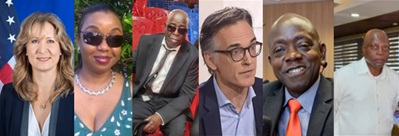
Across the Liberian communities at both home and the diaspora, there is an on-going debate regarding how certain witness statements and evidence were gathered, verified, processed and presented in several Liberia-related war-crimes investigations. These cases involved support from Civitas Maxima (CM)-led by Alain Werner in Switzerland, the Global Justice Research Project (GJRP), led by Hassan Bility in Liberia, and the Center for Justice and Accountability (CJA) in the United States, led by Allan White.
Some stakeholders and community dwellers knowledgeable about what transpired in Liberia during the country’s civil war have begun to ask the hard questions about the alleged inaccurate, uncorroborated, or inconsistent so-called source statements. These so-called witness statements may have been used in submissions to Western investigative bodies. Unfortunately, all NGOs involved firmly deny wrongdoing, maintaining that they followed ethical and professional standards throughout their work.
After losing three landmark cases in a row, broader discussion now centers on whether verification, cross-checking, and source reliability were consistently upheld in the below listed cases:
The Case of Col. Moses Thomas: In several confidential reports, reporting NGOs alleged that former SATU Commander, Col. Moses Thomas, played a role in cold-blooded murder surrounding the J.J. Roberts United Methodist School and the St. Peter’s Lutheran Church Massacre in July 1990.
However, numerous religious, civic, and community figures familiar with the events have publicly stated that they did not identify Col. Moses Thomas as present or involved.
However, comments pointing to inconsistencies came from Dr. Amos Sawyer (late Interim President of IGNU), Bishop Eddis Diggs, Rev. Budu Shannoh, Dr. H. Boimah Fahnbulleh (former IGNU Special Envoy) and various church leaders familiar with the incident.
Also, former TRC Chairman, Cllr. Jerome Verdier, who served on the Lutheran School Board, has also said publicly that Col. Moses Thomas’s name did not appear in the internal reviews he participated in. Verdier has additionally alleged witness coaching by certain NGOs—an allegation those involved organizations have since rejected.
These conflicting accounts circulated by international war crime investigators and institutions continue to raise questions about the origin and verification of the initial allegations.
Another case in question is the Agnes Reeves Taylor’s legal lawsuit. Concerns about the reliability of evidence also came to the forefront in the UK prosecution of Agnes Reeves Taylor. Statements presented by NGOs to international war crimes investigators and institutions included claims that Taylor-Reeves ordered one Morris Jabateh to kill Margibi County Superintendent, Amos Bohn.
According to the United Kingdom Indictment of Taylor-Reeves, it alleged that health workers were executed at Du-side Hospital, Firestone Division 10, on her orders. But unfortunately, according to UK court findings, Superintendent Amos Bohn was later found alive in the United Kingdom, contradicting claims of his death and there was no corroborated evidence supporting the alleged killings of health workers. The judge concluded that the evidence did not meet the legal threshold required, and the case was dismissed in 2019.
The dismissal of Agnes Reeves Taylor’s case by the United Kingdom court has intensified community concerns regarding the reliability of some statements submitted to foreign authorities.
Another huge setback for the global war crimes investigators was the Gibril Massaquoi case held in Finland.
The trial of Gibril Massaquoi in Finland also brought attention to potential inconsistencies in witness accounts. Public reporting and trial records indicate that Hassan Bility, Executive Director of the Global Justice Research Project, alleged that Gibril Massaquoi tortured him under the instruction of the late Liberia Police Director, Joe Tate.
According to witnesses presented by Hassan Bility and Alain Werner, Executive Director of Civitas Maxima, Massaquoi carried out killings and traveled across Liberia in 2002. Another eyewitness statement claimed that he was tortured at Clay, Bomi County, and imprisoned on orders from Police Director Joe Tate.
However, historical records show that Director Joseph Tate died in 1999, raising doubts about the accuracy of that testimony. Such inconsistencies became central to the court’s examination of the evidence, and the trial ultimately ended in acquittal.
The international war crimes community losing three major landmark cases in a row, owing to false statements and alleged witnesses coaching, especially by Hassan Bility, Executive Director of Global Justice Research Project, and Alian Warner, Executive Director of Civitas Maxima, has raised serious credibility concerns. These high-profile cases have led many Liberians to raise broader questions, including, but not limited to, how were witness statements collected and verified? Were the accounts cross-checked with independent evidence? Did any statements rely on hearsay or unclear sourcing? Were Western authorities presented with incomplete or inaccurate information? Or could misunderstandings, coaching, or incentives have unintentionally shaped some testimonies?
There have also been public discussions—without official confirmation—suggesting that certain investigative materials may have been shared with U.S. lawmakers without full context regarding their sourcing or reliability. Some observers additionally noted that when the U.S. State Department’s Office of Global Criminal Justice was dissolved by the Trump administration, funding streams connected to the “Liberia Justice Project” changed, raising further questions about oversight.