
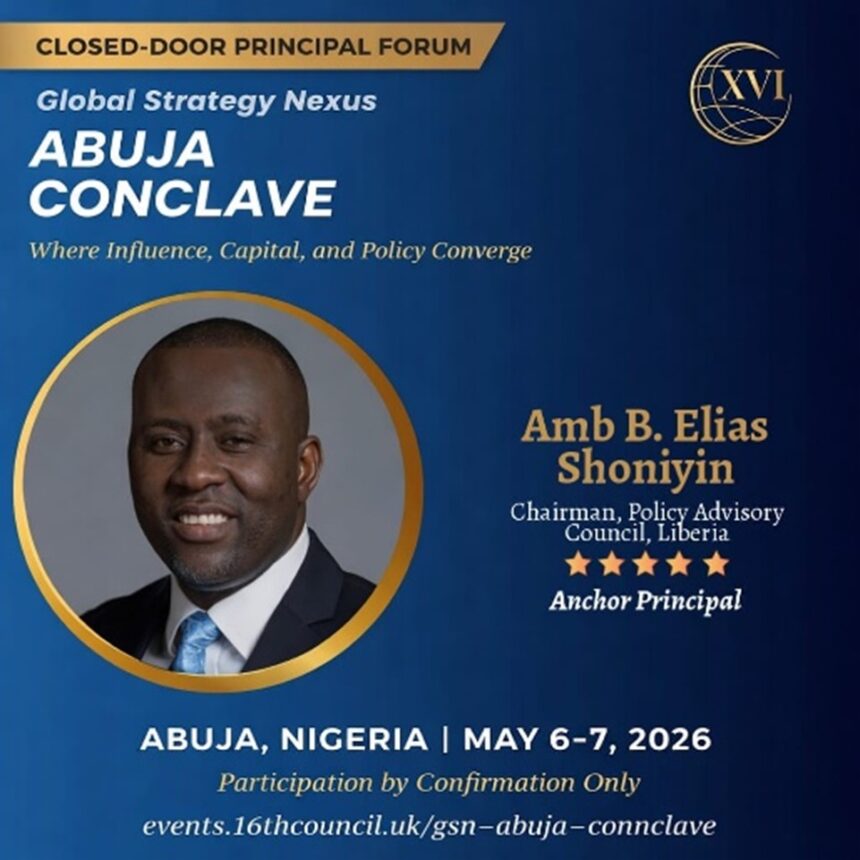
On May 6—7, 2026, Ambassador B. Elias Shoniyin, Chairman on the Policy Advisory Council (Liberia) and Anchor Principal of the Abuja Conclave, participated in the Sixteenth Edition of the conference—a closed strategic forum on Africa’s position in the next global order—which was held in Abuja, Nigeria.
At a moment when global power is being restructured and rules are no longer negotiated but imposed, the Abuja Conclave convenes a closed circle of principals to confront the issue of what Africa must control, align, or forgo now to avoid permanent rule-taker status in the emerging global order.
In a ten-minute presentation, Ambassador Shoniyin observed that Africa’s future socio-political and economic transformation depends on building strong, lawful, and resilient systems that outlive political administrations and personal leadership. He noted that sustainable progress cannot rely on personalities, informal arrangements, or short-term political interests; it must be anchored in legally institutionalized reforms, accountable governance structures, and long-term national development frameworks.
“The way forward for Africa requires a deliberate shift from politics driven by patronage, ethnicity, and short-term populism toward governance rooted in meritocracy, competence, economic rationality, and service to citizens. Governments must prioritize people-centered policies that improve livelihoods, expand opportunity, and strengthen public trust, while ensuring that appointments and decision-making processes are based on qualification and performance rather than identity or political loyalty,” he stated.
Ambassador Shoniyin underscored that Africa must also recognize that while cultural transformation is important, the fastest and most practical route to progress lies in policy and institutional reform, noting that strong institutions, functional systems, and enforceable laws create continuity, stability, and efficiency even during political transitions. “This includes strengthening judicial systems, public administration, leadership succession mechanisms, and anti-corruption frameworks to prevent institutional decay and governance regression,” he noted.
He however pointed out that economic transformation will require Africa to become more strategically open to investment and global capital while protecting national interests through technically sound negotiations and competent economic management.
“Investment-friendly environments built on transparency, stability, infrastructure, education, and rule of law are essential for attracting sustainable development financing and industrial growth. At the same time, African governments must ensure that foreign partnerships and concession agreements are negotiated by experts capable of securing equitable and development-oriented outcomes,” he added.
He emphasized that education remains central to Africa’s long-term advancement, and that universal and high-quality education must be treated not only as a social service but as a strategic national investment in human capital, innovation, productivity, and democratic participation.
“Empowered and educated citizens are critical to sustaining reforms, resisting manipulation, and strengthening accountability,” he maintained.
The seasoned diplomat highlighted that the continent must also confront the political and social realities that often obstruct reform, including entrenched interests, ethnic divisions, weak institutions, and resistance from existing power structures. According to him, addressing these challenges requires sustained public engagement, civic empowerment, institutional strengthening, and broad national consensus around development priorities.
“Ultimately, Africa’s progress will depend on its ability to build effective systems that combine visionary leadership, institutional continuity, economic pragmatism, and social inclusion. The continent’s future lies in transforming governance from personality-driven politics into system-driven development—where laws, institutions, competence, and strategic planning become the foundation for stability, prosperity, and global competitiveness in the 21st century,” he noted.
The Abuja Conclave is much more than a conference; it is a closed strategic forum on Africa’s position in the next global order, and a principal-only formation platform where those with authority-to-act engage directly with decisions that carry institutional and capital consequence.
It is a high-stakes working environment where principals test positions, confront trade-offs, and shape outcomes across capital deployment, institutional direction, strategic sectors, and execution pathways.