
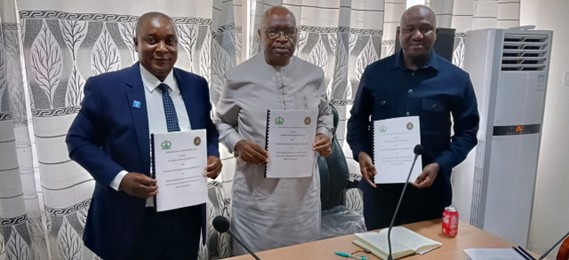
The Liberia Immigration Service and its counterpart, the Sierra Leone Immigration Department, have signed a memorandum of understanding (MoU) aimed at institutionalizing a bilateral immigration cooperation framework between the two countries.
The signing ceremony formed part of a recent official courtesy and working visit by the Liberian delegation to the Republic of Sierra Leone. The visit was intended to strengthen bilateral cooperation in border management, migration governance, and regional security.
According to the two institutions, the engagement focused exclusively on immigration-related matters and sought to deepen institutional collaboration in addressing emerging migration and border security challenges affecting both countries and the wider sub-region.
Liberia and Sierra Leone share long-standing historical, cultural, and geographical ties, with active border corridors facilitating the movement of people and goods under the ECOWAS Free Movement Protocol. However, increasing cross-border movement continues to present challenges, including irregular migration, human trafficking, migrant smuggling, transnational organized crime, identity and travel document fraud, and other border security vulnerabilities.
Against this backdrop, the visit aimed to strengthen operational coordination and improve information-sharing mechanisms between the LIS and SLID in order to enhance collective responses to evolving migration and border security concerns.
Discussions during the meeting focused on several key thematic areas, including border security and management, irregular migration and human trafficking, intelligence and information sharing, migration governance, capacity building, and digital transformation in border management systems.
The two institutions also explored practical and sustainable approaches to improving coordinated border management, strengthening institutional partnerships, and enhancing operational effectiveness along shared border corridors.
Key objectives of the visit include strengthening bilateral cooperation between LIS and SLID; establishing structured mechanisms for information and intelligence sharing; promoting joint border management initiatives and operational collaboration; exchanging best practices in migration governance and enforcement operations; enhancing technical cooperation and capacity-building initiatives; and formalizing a memorandum of understanding (MoU) between both institutions.
The Liberia Immigration Service emphasized that border security cannot be managed in isolation, noting that threats affecting one country may have direct implications for regional peace, stability, economic development, and collective security across the sub-region.
The service further underscored that enhanced cooperation among immigration institutions within the Mano River Union and the ECOWAS region remains critical in addressing contemporary migration challenges and combating transnational criminal activities.
Expected outcomes of the visit include strengthened institutional partnerships, the establishment of secure communication channels between both institutions, enhanced operational coordination, and the development of sustainable cooperation mechanisms to address irregular migration and transnational crime.
The LIS delegation was headed by Commissioner General Elijah F. Rufus and included senior officers and technical personnel of the Service.
The Liberia Immigration Service reaffirmed its commitment to promoting regional cooperation, professional border management, and effective migration governance in support of national and regional peace and security.