
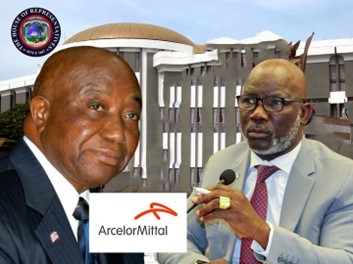
The Third Mineral Development Agreement (MDA) between the Government of Liberia (GOL) and ArcelorMittal has been received by the House and Senate’s Committees on Concessions & Investment; Mines, Energy, Natural Resources and Environment, and Judiciary, to be reviewed and ratified.
The agreement, which was formally submitted on Tuesday, during the first day sitting of the Third Session, by President H.E. Joseph N. Boakai, Sr., concerns the Mineral Development Agreement between the Government of Liberia, ArcelorMittal Holdings AG, ArcelorMittal USA Liberia Holdings LLC, and ArcelorMittal Liberia Limited, with the latter serving as the operating company.
In his communication, President Boakai reminded the Legislature that the original MDA was entered into on August 17, 2005, ratified by the Legislature, signed by the President, and published into handbills. The agreement was subsequently amended on December 28, 2006, and January 23, 2013.
Following extensive negotiations and consultations, the President informed lawmakers that the parties agreed to further amend certain provisions of the MDA. The Third Amendment, signed on December 20, 2025, restates the agreement in its entirety, consolidating all prior amendments into a single, fully amended document.
According to the Liberian leader, key features and strategic benefits of the Third Amendment include: Railroad System Operating Principles (RSOP)—the Government of Liberia is granted the right to establish a multi-user rail regime under a new RSOP framework, ensuring non-discriminatory access to the Yekepa–Buchanan rail corridor. The framework provides for a transition to an independent, government-regulated rail authority by 2030, consistent with Liberia’s long-term national rail vision; extension of agreement term—the duration of the MDA is extended to December 20, 2050, with an option for renewal; and expansion of Production Capacity—ArcelorMittal Liberia commits to increasing production capacity from 15 million wet metric tons per annum (MWMTPA) by 2027, to 20 MWMTPA by 2031, and up to 30 MWMTPA thereafter.
Other benefits include upfront payment—upon ratification, ArcelorMittal Liberia will make an upfront payment of US$200 million to the Government of Liberia (GOL); and increased mining license fee—the annual mining license fee will increase from US$50,000 to US$500,000.
Additionally, ArcelorMittal Liberia will contribute US$5 million annually to a Community Development Fund (CDF) to support socioeconomic development within the concession areas. The company will also submit a Social Infrastructure Plan covering Nimba, Bong, and Grand Bassa counties, including rehabilitation of the KM 2.5 Bridge linking Buchanan City Center to the concession loop; paving of the concession road over the KM 2.5 Bridge to Tubman Street in Buchanan; rehabilitation of the St. John River Road Bridge connecting Bong and Grand Bassa Counties; establishment of a Vocational Training Center (VTC) in Buchanan; and continued housing rehabilitation, education, and employment programs.
However, delays in implementation will attract penalties ranging from US$250,000 to US$500,000 annually in additional CDF contributions.
The agreement also guarantees increased participation of qualified Liberians, including 50% of management positions by the third anniversary; one of four concessionaire officers by the first anniversary; 75% of professional, administrative, and technical positions by the fifth anniversary; and 90% by the tenth anniversary, subject to Liberia’s Labor Practices Law.
ArcelorMittal Liberia also agrees to prioritize local procurement of goods and services across its mining, rail, and port operations, and to provide an annual contribution of US$500,000 to support education and skills training programs.
Meanwhile, President Boakai emphasized that the Third Amendment represents a significant advancement in economic development, infrastructure modernization, and community empowerment, and aligns with the government’s ARREST Agenda for Inclusive Development.
He urged the National Legislature to give the agreement favorable consideration and ratification.