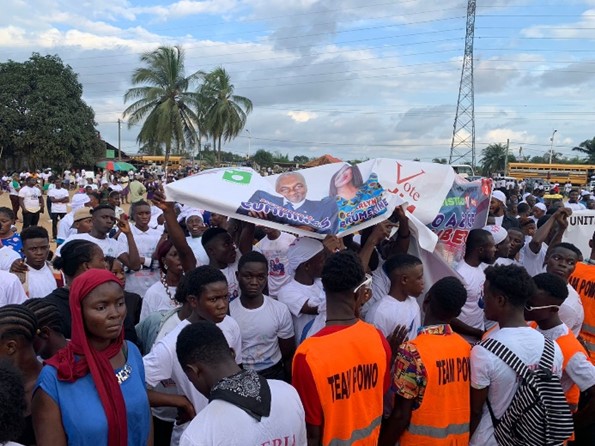


The Peoples’ Party (TPP) has been established under the leadership of Joseph K. Bannie, with a comprehensive platform aimed at rebuilding the nation through justice, inclusion, and economic empowerment.
The party’s philosophy emphasizes equality, justice, and participation for all Liberians, especially indigenous citizens who, according to the party’s statement, have been marginalized in political and economic systems since independence.
The Peoples’ Party has outlined its economic foundation as a free enterprise system driven by competition, private ownership, and equal opportunity. The party’s five guiding principles include freedom of business choice, private property rights, competition, customer sovereignty, and profit motivation.
According to the document, the new system aims to remove monopoly practices and encourage all Liberians to pursue business ambitions without elite interference. The plan includes government oversight to maintain price ceilings while ensuring fair competition in the market.
TPP has placed justice at the core of its agenda. The party proposes immediate implementation of the Truth and Reconciliation Commission’s (TRC) recommendations, including the establishment of War and Economic Crimes Court.
The plan calls for a justice system capable of attracting foreign investment, reducing crime, and recover all government loses. The party also plans to audit past governments to uncover and address corruption.
The Peoples’ Party said it envisions an inclusive government with 85% of new and qualified Liberians in the cabinet. A proposed Peoples’ Council (TPC) will represent major sectors, including education, medical, security, women, youth, and traditional leadership. The council will review presidential appointments and executive bills before legislative confirmation.
Immediate reforms would include restructuring fuel distribution, shipping regulations, business operations, and government salaries. All government vehicles would be limited to one per official, while contracts and concessions would be revisited to ensure national benefit.
Security reform is another top priority for TPP. The plan includes rebuilding Liberia’s military under four branches: Army, Marine Corps, Air Force, and Coast Guard. Each branch will receive modern logistics and training to address both internal and external threats.
The Liberian National Police (LNP) will also undergo reform with technology-driven training, modern facilities, and specialized equipment. Police zoning will be introduced in large cities to improve efficiency with responses.
To address Liberia’s healthcare challenges, TPP plans to build and remodel hospitals and clinics across the country. The initiative includes government payment for all medical bills for senior citizens and children under 18.
The plan also emphasizes integrating traditional medicine, ensuring modern healthcare technology, and creating jobs for doctors and nurses through nationwide hospital expansion.
Education reform will focus on free schooling from kindergarten through high school and government-sponsored adult literacy programs. Schools will be built or renovated in all communities, equipped with laboratories, libraries, and vocational centers.