
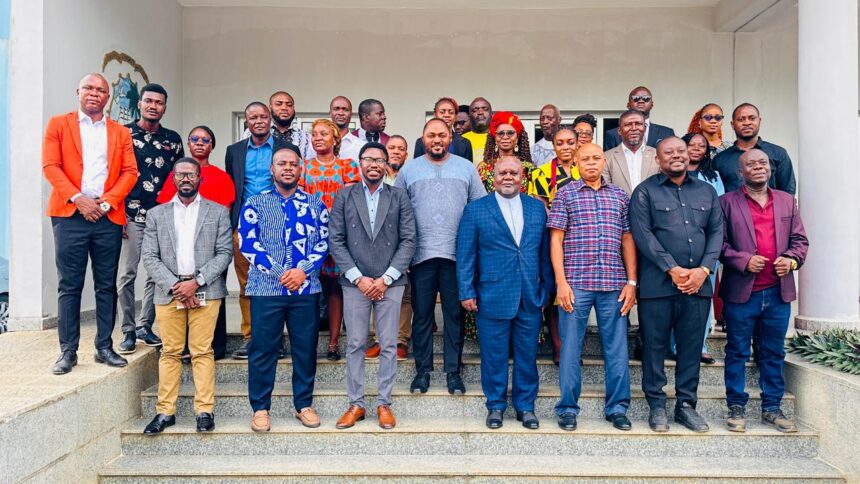
The Liberia Maritime Authority (LiMA), in collaboration with key stakeholders in the maritime sector and with support from Conservation International (CI), has officially launched Liberia’s Marine Spatial Plan (MSP), a landmark framework designed to strengthen ocean governance and protect the country’s marine and coastal ecosystems.
The launch ceremony was held at LiMA’s headquarters in Congo Town, and brought together representatives from major government ministries and agencies, including the Environmental Protection Agency (EPA), the National Fisheries and Aquaculture Authority (NaFAA), the National Oil Company of Liberia (NOCAL), the Liberia Petroleum Regulatory Authority (LPRA), the Liberia Petroleum Refining Company (LPRC), academia, and other strategic partners.
Welcoming participants, Bohmensahn B. Yuan, Director of Marine Environmental Protection at LiMA, described the occasion as a defining moment in Liberia’s ocean governance journey.
“We are gathered here at a moment of transition, one that calls on us to put deliberate efforts into protecting our ocean, which remains a vital engine of Liberia’s future,” Yuan said. “Let us use this Marine Spatial Plan to safeguard Liberia’s ocean so that it continues to provide for future generations.”
Delivering special remarks, John F. Harvey, Deputy Commissioner for Domestic Vessels Registration and Safety, emphasized Liberia’s vast coastline and rich ocean resources, noting their critical importance to food security and national economic growth.
According to Deputy Commissioner Harvey, the long-term viability of these resources depends on a coordinated and modern approach to marine management.
“This Marine Spatial Plan lays out the fundamental and operational pillars from data collection and legal analysis to stakeholder engagement, zoning, and monitoring that will guide how Liberia manages its marine resources in the years ahead,” he explained.
He reaffirmed LiMA’s commitment, alongside NaFAA and other partners, to ensuring the transparent, science-driven, and inclusive implementation of the plan, with strong community participation.
“Let this framework be a catalyst for a new era of ocean governance in Liberia, an era defined by balance, sustainability, and shared prosperity. We invite all stakeholders and partners to join us in this critical national endeavor,” Harvey stated.
Speaking on behalf of Conservation International, Momodu Kemokai, CI Country Director, described the launch of the MSP as a “vital step forward” for Liberia’s ocean governance, particularly for coastal communities whose livelihoods depend on healthy marine ecosystems.
“The Marine Spatial Plan provides Liberia with a clear, science-based roadmap to balance the multiple uses of ocean space while ensuring that marine resources remain healthy and productive for generations,” Kemokai said.
He extended appreciation to the Swedish International Development Agency (SIDA), the Embassy of Sweden, the European Union, and other partners for providing scientific tools and technical expertise that supported the development of the plan.
“Conservation International reaffirms its long-term commitment to supporting the Government of Liberia (GOL) and coastal communities in bringing this plan to life,” he added. “Our mission is to help societies responsibly and sustainably care for nature, and the MSP represents exactly that planning that puts communities, ecosystems, and national development priorities at the center.”
Kemokai underscored that implementation will be key to success, noting that effective execution will lead to stronger fisheries management, improved livelihoods, healthier coastal habitats, increased investor confidence through clear regulations, and a more resilient Liberia.
Representatives from NaFAA, LPRA, LPRC, the University of Liberia, and the African Methodist Episcopal University (AMEU) also spoke at the event, unanimously calling for sustained capacity building and inclusive implementation to ensure the plan reflects stakeholder aspirations and delivers tangible benefits to targeted communities.