
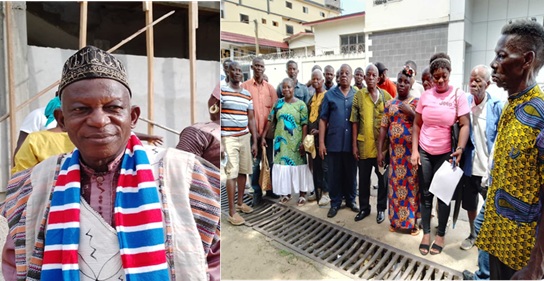
As surviving families and former employees of the National Iron Ore Company’s October 6, 1982 Mano River Landslide catastrophe are still crying to the Government of Liberia (GoL) for their severance pay and benefits, today marks 43 years since the deadly incident occurred.
“On that memorable morning of October 6 1982, at 2:30 a.m. while each and everyone of the No-Way Camp in Grand Cape Mount was in deep sleep, the camp suddenly came under a river of thick clay mixed with large stones and huge forest trees—all from one of the seven mountains (H-Hill) that was being mined by the then National Iron Ore Company,” recalled M. James Mafarlon, General Chairman of former NIOC workers.
James said the NIOC was 85% owned by the government, and with at least 1,820 employees at the time, but in No-Way Camp over 1,000 living bodies, including men, women, babies, pregnant women, even strangers who went to visit loved ones, and some Fulani who were shepherding cows, sheep, and goats below the very mountain, were buried.
With all efforts made by the management of the company and GoL, only 51 dead bodies were discovered, using earth-moving equipment, Mafarlon revealed.
“My dear people of Liberia, will you agree that this was just the beginning of tremendous suffering for the people within that western belt? Countries that came to our cries, including the government, donated cash and kinds at the sympathy of the survivors for their relocations. With the budget of 12 housing units to be built, only 9 were built, and the rest of the cash and kinds went into some unknown pockets in Liberia,” he stated.
According to the general chairman of the former NIOC employees, the company started its operation in 1961 after signing a mining concession agreement with the Government of Liberia (GOL) for 25 years, and in 1978-79 US$67 million was borrowed from the World Bank (WB) to renew some mining equipment, including the railway (train track). This money was properly being used up to 1980 when a coup took place in Liberia and the country found itself under a military regime.
“When the company noticed that the borrowed US$67 million was being used on the contrary, it requested to GoL that since, indeed, the government was unable to provide its quota in cash, as usual, for the operation to continue, all operation should be suspended until at a time the GoL is able to play its part in cash, but all employees should be redundant with their benefits, and re-employed when the operation resumes. All this happened in March 1985. But on the contrary, GoL requested that all expatriates be paid off and all Liberians would be paid by her (GoL) at a later date,” Mafarlon disclosed.
Against this backdrop, Mafarlon explained, the company paid all expatriates, including making provision for their plane tickets for departure back home and physical cash, and turned over to GoL the Liberian employees for payment. The government then ordered the company to shut down, which it did.
“When we noticed government’s delay to pay, a court action was taken against her by the workers at the People’s Debt Court. The decision came down in favor of the workers, that all workers be paid their just benefits, including 6% interest to every dollar in USD. The records are there,” he stated.
He went on, “When GoL knew that our money had been used by her, she (GoL) gave a promissory note to each employee: in the event the company does not resume operation as expected, all assets of the erstwhile NIOC would be sold and proceeds paid to the workers. This was in 2001. Also, any company that would succeed NIOC, an upfront payment made to GoL will be used to pay all workers’ severance and other benefits. From that time up to 2001, only one percent (1%) of our severance has been paid to us, balancing 99%. The records are there,” the former NIOC employees’ General Chairman explained.
He voiced that, while waiting all these many years with continued request every year to the sitting President, in 2011 during the administration of President Ellen Johnson-Sirleaf, Westerrn Cluster Limited came in and signed a mining concession agreement with GoL and made an upfront payment in the tone of US$40.5 million, with the expectation that our benefits would be settled by GoL.
“But on the contrary again, government made use of the money without paying us a dime. Our severance and other benefits are in the tone of a little over US$15.5 million,” he despondently pointed out.
He said since the government is reneging to pay them their severance and other benefits cash down, “we have appealed on several occasions that this severance and other benefits be placed within the GoL budget for payment. This, again, seems to be falling on deaf-ears.”
“The erstwhile National Iron Ore Company (NIOC) was represented by employees from the 15 counties, some of whom are still in Mono River today for shame that they can’t outlive their useful lives working for a company that is owned by GoL at 85% share and expect to go home empty-handed after working many years. What can you do, President Joseph Boakai, to help these 1,820 former employees, excluding their wives, children and grandchildren, some of whom are still waiting to hear from GoL? We need an audience with you, Mr. President,” Mafarlon craved.