
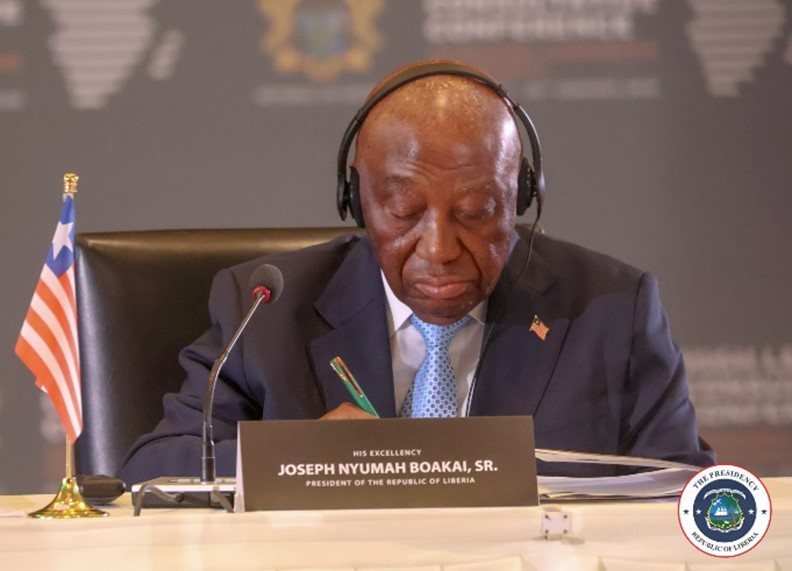
President Joseph Nyuma Boakai Sr. has called on West African leaders to urgently strengthen regional cooperation and collective security, warning that no nation can remain stable while its neighbors face insecurity and terror.
Speaking at the High-Level Consultative Conference on Regional Cooperation and Security on Friday, January 30, 2026, in Accra, Ghana, President Boakai emphasized that the evolving security landscape in the region demands immediate, coordinated, and decisive action by states.
“None of us can be peaceful and stable if any of us is insecure and terrorized. Liberia is not safe if an inch of Ghana is in terror,” the President declared.
The Liberian Leader described recent developments in Niger as a “rude awakening and a crude reminder” of the persistent and interconnected threats confronting the region, noting that the conference could not have come at a more critical moment. He urged the gathering to convey Liberia’s solidarity to the people of Niger.
President Boakai expressed appreciation to H.E. John Dramani Mahama, President of the Republic of Ghana, for convening the conference and for the warm hospitality extended to him and the Liberian delegation. He reaffirmed Liberia’s full support for the initiative and its outcomes.
Drawing from Liberia’s own painful history, President Boakai underscored the devastating and lasting consequences of violent conflict, underscoring that wars know no boundaries and leave nations deeply scarred. He reaffirmed Liberia’s strong commitment to conflict prevention at national, regional, and international levels.
The President outlined a broad range of threats facing the region, including terrorism, violent extremism, governance deficits, transnational crime, maritime insecurity, climate-driven conflicts, illicit mining, arms proliferation, human trafficking, cybercrime, drug abuse, and youth unemployment. He noted that non-state actors exploiting anarchy and lawlessness continue to undermine peace and stability.
President Boakai warned that increasing global polarization, economic disruptions, and political uncertainty are compounding insecurity and poverty, particularly for smaller and developing states. In this context, he maintained the continued relevance of multilateralism and regional solidarity.
As a non-permanent member of the United Nations Security Council, President Boakai highlighted Liberia’s advocacy for a regional approach to peacebuilding and security, noting that effective responses must involve neighboring countries and regional institutions to dismantle cross-border networks that sustain conflict and terrorism.
He welcomed the outcome document produced by Intelligence Chiefs and Ministers responsible for Foreign Affairs and National Security, and reaffirmed Liberia’s readiness to work with regional partners to implement its recommendations.
Addressing socio-economic drivers of insecurity, President Boakai called for renewed activation of existing regional mechanisms to promote economic growth, job creation for young people, skills training, education, healthcare cooperation, and cultural exchange.
In closing, President Boakai emphasized four key truths, including the urgency of collective action and the need to invest in modern security architecture to match advances in technology.
“We are here because there is only one option: our collective survival and the survival of our people,” he said.