
In a landmark declaration, two hundred twenty-eight paramount chiefs from across Liberia, represented by their county chairpersons, have voiced strong support for the establishment of a war and economic crimes court and an anti-corruption court.
The chiefs issued their position statement on Tuesday, February 10, at the conclusion of a two-day national dialogue focused on two draft laws that would create these courts. They described the dialogue and its outcome as “the surest way to guarantee justice and accountability in Liberia”.
The dialogue was organized by the Office for the Establishment of War and Economic Crimes Court for Liberia, in collaboration with the Ministry of Local Government represented by Joseph Cooper, Executive Director of the Chief Support Office at the Local Government Ministry.
Transitional Justice analysts believe that the declaration of support read by Chief Nelson Neal of Maryland County marks one of the most unified endorsements yet from traditional leaders, who play a critical role in shaping public opinion and governance at the community level.
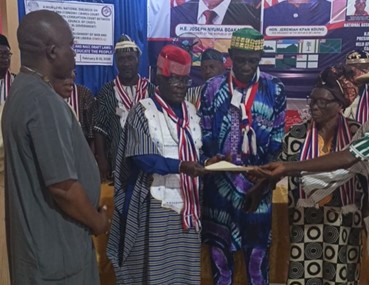
Presenting the statement to the OWECC-L Executive Director, Rivercess County Chairman, Chief Kofi Zaar, said the statement was a demonstration of their unflinching support to the process leading to the establishment of the two courts.
The chiefs, who also offered prayer service for Dr. Barbu, want to form part of the planning and presentation even where the two draft laws are officially presented to His Excellency, Joseph Nyuma Boakai, President of the Republic of Liberia.
Responding, OWEEC Executive Director, Dr. Cllr. Jallah A. Barbu, promised to live up to the expectation of the chiefs and elders of Liberia.
OWECC L Executive Director said he believes Liberia’s journey toward justice and transparency must be inclusive, and by engaging chiefs and elders will ensure that the voices of local communities are heard, respected, and reflected in the nation’s laws.
“By the Grace of God all that is written in this support statement will fully be implemented,” Dr. Barbu is quoted as telling the chiefs.
Liberia’s history is scarred by years of civil conflict, during which thousands of lives were lost and communities devastated. Calls for accountability have echoed for decades, with many citizens demanding justice for atrocities committed during the wars.
The proposed War Crimes Court seeks to investigate and prosecute individuals responsible for crimes against humanity, war crimes, and other grave violations. The Anti-Corruption Court, for its part, would target systemic corruption, a challenge that has long undermined Liberia’s governance and economic development.
By backing these courts, the Paramount Chiefs are aligning themselves with civil society organizations, victims’ groups, and international partners who have consistently advocated for justice and reform.
During the dialogue, county chairpersons emphasized that justice cannot be delayed any longer. One representative stated, “Our people have suffered for too long. Establishing these courts is not about revenge, but about ensuring that truth, accountability, and reconciliation are finally achieved.”
Others highlighted corruption as a root cause of poverty and instability. They argued that without a dedicated Anti-Corruption Court Liberia’s progress will remain stunted.
They described the dialogue and its outcome as “the surest way to guarantee justice and accountability in Liberia”.
The chiefs’ collective statement underscored their commitment to supporting the government and Legislature in passing the draft laws. They urged lawmakers to act swiftly, noting that communities across Liberia are ready to cooperate in the pursuit of justice.
The chiefs’ endorsement carries significant weight as traditional leaders remain influential in Liberia’s political and social fabric, often bridging the gap between government and rural communities. Their support could help build momentum for legislative approval and eventual implementation of the courts.
Civil society organizations attending the dialogue termed the moment could mark a turning point in Liberia’s long struggle with impunity and corruption. If enacted, the courts would not only deliver justice for past crimes but also strengthen institutions to prevent future abuses.
As Liberia stands at this crossroads, the voices of its Paramount Chiefs send a clear message—justice and accountability are non-negotiable for the nation’s future.