
NAYMOTE-Liberia has released its President Meter Report on the implementation of the ARREST Agenda for Inclusive Development (AAID), revealing that the agenda is still in its earliest stages of activation.
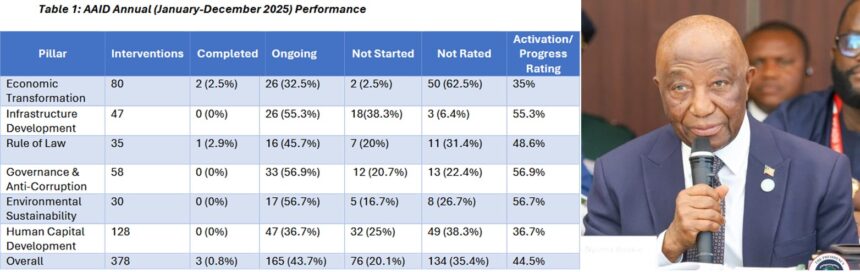
According to the report, after twelve months of implementation (January—December 2025), only 0.8% of interventions have been completed, 43.7% are on-going, 20.1% have not started, and 35.4% remain not rated due to inconsistent reporting and poor information sharing across government institutions.
The report revealed that progress differs markedly across pillars. “Governance and Anti-Corruption, Environmental Sustainability, and Infrastructure Development demonstrate comparatively stronger activation rates, while Economic Transformation and Human Capital Development continue to face significant information gaps and slow implementation. Service delivery remains heavily centralized, with 60.7% of county-level services unavailable and 85.7% requiring citizens to travel to Monrovia for processing, increasing both financial and accessibility burdens,” the President Meter Report disclosed.
However, the report observed that despite these challenges, this year demonstrates that meaningful progress is achievable, if recommendations are highly taken. “Institutional establishments such as the Office of the Ombudsman and the War and Economic Crimes Court Secretariat, digital reforms, including biometric ID enrollment expansion and e-procurement pilots, judicial modernization efforts, and selected social program advancements, amongst others confirm that results are attainable when political will, resources, and technical capacity align.
“Overall, 2025 represents a foundation-building year for AAID. The findings highlight both opportunities for transformational progress and risks of stagnation if coordination, data management systems, and implementation discipline are not significantly strengthened,” the report noted.
NAYMOTE-Liberia pointed out that the AAID can still succeed, but only through decisive and systemic shifts that directly address the coordination gaps, resource constraints, and implementation weaknesses documented throughout this report.
In order for the AAID to succeed, NAYMOTE-Liberia recommended that the government establishes an empowered central coordination mechanism, ideally a high-level AAID Secretariat operating under the Executive Office with the authority to convene, direct, and hold MACs accountable for timely, accurate, and results-oriented implementation.
Also, NAYMOTE said, high-impact interventions must be accelerated, including biometric ID expansion, e-procurement rollout, priority road corridors, school feeding expansion, and healthcare service delivery since these generate visible benefits and unlock progress across multiple pillars.
The civil society group underscored that Liberia must implement genuine decentralization, granting counties real fiscal and administrative authority through the operationalization of Revenue Sharing Regulations, delegated approval systems, and strengthened county capacity. “Closing Liberia’s implementation gap requires adequate and predictable financing, achieved through expanded domestic revenue mobilization, stronger development partner alignment, viable public–private partnerships, and significant improvements in budget execution,” the group added.
The group emphasized that transparency and accountability must be institutionalized, including quarterly public reporting, a unified AAID tracking dashboard, systematic citizen feedback integration, and consequences for persistent non-performance. “The government must build implementation capacity across MACS, including workforce strengthening, training, systems development, and performance management reforms aligned with AAID requirements.
“Finally, the AAID’s success depends on the transformation of human capital investment, acknowledging that Liberia’s people are its greatest asset. This requires meeting the target of allocating 15% of the national budget to health, scaling proven social programs, coordinating education–health–youth interventions, and ensuring equitable service delivery across counties. Without these structural shifts, the AAID risks falling into the pattern of previous plans that promised much but delivered little,” the President Meter Report further observed.
The report warned that, without these shifts, the AAID risks joining previous development plans as unfulfilled promises rather than catalysts for transformation. The choice is clear: incremental adjustments will not suffice transformative action is required.