
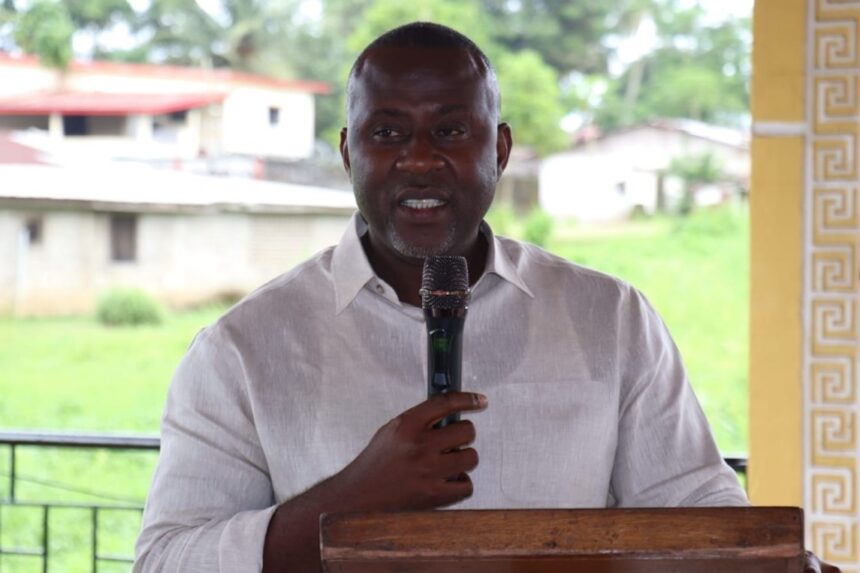
Distinguished Chairperson of the Press Union of Liberia – Grand Bassa Chapter, Elton Wroinbee Tiah;
Secretary General, King Brown;
Members of the PUL Grand Bassa Executive;
Media Practitioners and Journalists;
Invited Development Partners;
Government Representatives;
Civil Society Actors;
Ladies and Gentlemen — Good Afternoon.
There was an old man in a village not far from Buchanan called Pa Tamba. Pa Tamba was the town chief — respected, gray-haired, commanding. Every time there was a community meeting, Pa Tamba would speak with great power. He would knock his stick on the ground and say: “I am accountable to this community! I serve the people! I am transparent in all my dealings!”
One day, a young journalist from one of the local radio stations here went to do a story on Pa Tamba’s administration. She asked: “Pa Tamba, the bridge the government funded — where is it?”
Pa Tamba laughed loud with deep confident like a man who thought no one had been paying attention. “Ah, my daughter, he said, the bridge is coming. The money just need small time to reach.”
The journalist smiled and pulled out her notebook. “But Pa Tamba, the money reached two years ago. Here is the voucher. Here is the letter. Here is your signature.”
The whole community went quiet.
Pa Tamba looked left. He looked right. Then he said — and I want you to remember these words — “My daughter… you should have been a lawyer.”
(Laughter)
Ladies and gentlemen, that young journalist did not stop a crime that day — she prevented a generation of crimes from happening in silence. And that, my friends, is why we are here today.
I am deeply honored to be a part of this landmark occasion — the First ever Grand Bassa County Media Conference, convened under the inspired theme: “Strengthening Community Media for Development, Accountability, and National Progress.”
Ladies, and gentlemen, there is a truth I want you all to carry in your hearts when we leave here today: Liberia remains one of the poorest nations in the world. Over fifty percent of Liberians live below poverty line — and in rural areas like Grand Bassa County are even worst.
The poverty of Grand Bassa’s hinterland communities is not accidental. It is the product of decades of neglect, governance failures, and — critically — silence. The silence of those who saw wrong and said nothing. The silence of those who had the pen in their hands and chose not to use it.
As journalists of Grand Bassa County, you are here today to end that silence.
Let me speak to you honestly: a county without a functioning press is a county without a mirror. Without you, Grand Bassa will never see itself clearly to know that there is an urgent need for change.
Consider this: Liberia currently ranks 58th out of 180 countries on the 2026 World Press Freedom Index. As recently as 2022, we were ranked 75th. The improvement matters — it tells us that the political conditions for journalism are getting better. But a good ranking is only the stage; what you perform on that stage is your responsibility.
The press is democracy’s immune system. When the immune system is weak, disease spreads unchallenged. Corruption spreads. Incompetence spreads. Injustice spreads. But when the immune system is strong — when journalists are diligent, courageous, and principled — the body politic can fight off its worst enemies.
As the great American jurist Hugo Black once wrote: “The press was to serve the governed, not the governors.” And I will add: not the superintendents. Not the lawmakers, nor the ministers.
Instead, the children, the farmers, the market women, the students, the pregnant mother who walks many hours to reach a clinic. Those are your clients.
And Thomas Jefferson — a man who, it must be noted, was both celebrated and tormented by the press — said: “The only security of all is in a free press.”
Think about what that means for Grand Bassa. Your security — the community’s security — depends on a free, active, responsible press.
Let me say something that might make some people in the county uncomfortable — and I say it with love: leaders behave better when they know someone is watching and will report what they see.
I must also speak to your responsibility as journalists— because the power of the press is not simply a license to practice; it is trust of the people you serve.
I have seen journalists in this country who have turned the pen into a weapon for extortion. Who write stories — or threaten to write stories — not to serve the public, but to serve their private interests. I say to you today: that is not journalism. That is dressed-up fraud.
(Mild laughter from the audience)
I am serious, my friends. Journalism’s moral authority rests entirely on one foundation: the truth, told without fear or favor. When you compromise that — when you accept money to kill a story, when you shade the truth to protect a political ally, when you promote propaganda as news — you do not just betray your profession. You betray the 293,689 people who live in this county and who depend on you to be their eyes and ears.
As the legendary Walter Lippmann put it: “There can be no higher law in journalism than to tell the truth, and to shame the devil.”
Honesty means you call a spade a spade — even when the person holding the spade is your relative, your tribal kinsman, or the man who gave your organization a donation.
Accountability means you are willing to be held to the same standard you apply to others. You correct your mistakes. You issue retractions when you err. You do not hide behind a microphone to avoid accountability for your own conduct.
Transparency means your audience knows who you are, who funds you, and what interests you may have. In a country of increasingly politicized media, transparency is what separates journalism from propaganda.
I want to speak now to the deeper motivation for this work — because let me be honest with you: journalism in Liberia does not pay well. (Laughter.) The roads to the story are often bad roads. The electricity to charge your equipment is not always available. The person you want to interview sometimes does not want to be interviewed. And sometimes — as many of your colleagues know too well — the work you do carries physical danger.
So why do you do it?
You do it because you chose a field whose reward is far beyond yourself. You chose it because somewhere in you — perhaps when you were young, perhaps when you saw something unjust and felt powerless — you said: “I will not be silent.”
That is the fire that must never go out.
One of the profound truths about journalism is captured by this: “Journalism can never be silent: that is its greatest virtue and its greatest fault.” Silence, for a journalist, is professional death. But when you choose to speak — speak truthfully, courageously, and persistently.
I encourage you to adopt a philosophy of long-term community gain over short-term personal advantage. Journalists who build a relationship with powerful government officials in exchange for protection and small benefits may survive comfortably today. But the journalist who holds the powerful accountable — even at personal cost — is the one whose work outlives them. They are the ones who will change this county and who will change Liberia as a whole.
After many years of your journalist practice, what story do you want mourners to tell at your funeral?
Journalism is among the most honorable professions known to humanity. It is the profession that brings down corrupt governments. It’s the career that gives voice to the voiceless; it is the profession that tell the world about famines that would otherwise have gone unreported.
But journalism is also among the most demanding professions, because it requires you to understand nearly everything. The journalist covering health in Grand Bassa must understand epidemiology well enough to report on it accurately. Journalists covering mining concessions must understand contract law well enough to ask the right questions. Journalists covering agriculture must understand the supply chain well enough to see where farmers are being cheated.
You cannot amplify what you do not understand.
This is why lifelong learning is not optional for you — it is the price of relevance. You must read and take online courses as often as possible, and attend training workshops regularly. You must connect with your colleagues across Liberia and across Africa. The world is giving you free access to knowledge that previous generations of journalists could never have imagined.
And now — I have a word for the local leaders in this room. To the government officials, lawmakers, district commissioners, community leaders, and any national-level officials present here today.
The press is not your enemy. A functional press is, in fact, the best gift any government can receive. Why? Because it is free intelligence. It tells you what is working and what is not. It identifies problems before they become crises. It gives citizens a constructive channel for their grievances, which — when denied — tend to find destructive channels instead.
Grand Bassa needs you to govern with courage and vision. Not for the election cycle, but for the generation. Think about the child born in Number Four today — the one who will be eighteen in 2044. What Liberia will that child inherit? What Grand Bassa will she grow up in? Will she have electricity? Will she have a good road to take her farming products to the market? Will she have a hospital that she can reach when there’s a medical emergency?
These are the questions the press will hold you to. Not to embarrass you — but to lift you to your highest obligation.
A free county is not built by leaders alone. It is built by informed citizens, engaged journalists, honest officials, and active civil society — all pulling in the same direction.
To Chairman Elton Wroinbee Tiah, Secretary General King Brown, and all members of the Press Union of Liberia – Grand Bassa Chapter:
You have done something historic here today. You have convened the first-ever Grand Bassa Media Conference. You have planted a seed. What it grows into depends on what you do next.
Establish your chapter office — and run it with integrity. Let it be a place where journalists are trained, supported, and held to high standards. Let it be a sanctuary for truth in this county.
Adopt a code of ethics and enforce it. A union that protects bad journalism serves no one. A union that champions excellent journalism serves everyone.
Build relationships with the communities — especially the most remote villages. Go to Neekreen. Go to the St. John River District. Go to the deep bush. Because the people who live furthest from the capital are most likely to be forgotten by power and most likely to be helped by the truth you uncover.
And to the young journalists in this room: you are the future. Not someday. Today. The stories you tell this week will shape what citizens know, what leaders do, and what investments will come to this county— or don’t come — to this county. Do not underestimate your power.
Let me close with a short literature, from the rivers of Bassa.
The St. John River does not ask permission from the mountains before it flows. It does not wait for the government to approve its direction. It does not pause when rain fall or not. It simply moves — steadily, powerfully, truthfully — toward the sea. And because it moves, things grow along its banks. Children bathe. Farmers water their crops. Communities build themselves around its presence.
You — the press — are Grand Bassa’s St. John River. You are the flow of truth in a landscape that desperately needs it. Do not stop. Do not be subdued by political pressure. Do not be redirected by private interest. Flow my friends.
Flow for the farmer who has no one else to speak for him. Flow for the market woman who has nowhere to sell her goods. Flow for that school that doesn’t have a roof. Flow for the clinics that don’t have medicine. Flow for the child who has never seen a government official keep a promise. Flow for them — until the day they can flow for themselves.
Ladies and gentlemen, the Press Union of Liberia – Grand Bassa Chapter is not just an organization. It is a declaration — that in this county, truth matters, that accountability is demanded, that the people of Grand Bassa deserve leaders who govern for the living and not just for the powerful.
Let this conference be the beginning of that declaration made permanent.
Walter Cronkite said it best: “Freedom of the press is not just important to democracy — it is democracy itself.”
Today, Grand Bassa takes another step toward its democracy.
Congratulations to the PUL Grand Bassa Chapter. Long live the free press. Long live Grand Bassa. Long live Liberia.
Thank you.