
Members of the Executive and Legislative branches of the government have taken a common, unanimous position on President Joseph Nyuma Boakai’s call for the de-ratification of the Transatlantic International Alliance (TIA) Agreement with the Liberia Telecommunication Authority (LTA).
The country has been witnessing open friction between the Executive and the Legislature branches of government, sparked by President Boakai’s push to “de-ratify” the 2024 TIA Agreement, with lawmakers warning the move could undermine the rule of law and investor confidence.
The agreement gives TIA leverage to control and monitor telecommunication services in Liberia. President Boakai is now using executive powers to block its implementation, arguing for its reversal. But members of both the Executive and the National Legislature appear divided on the legality of that approach.
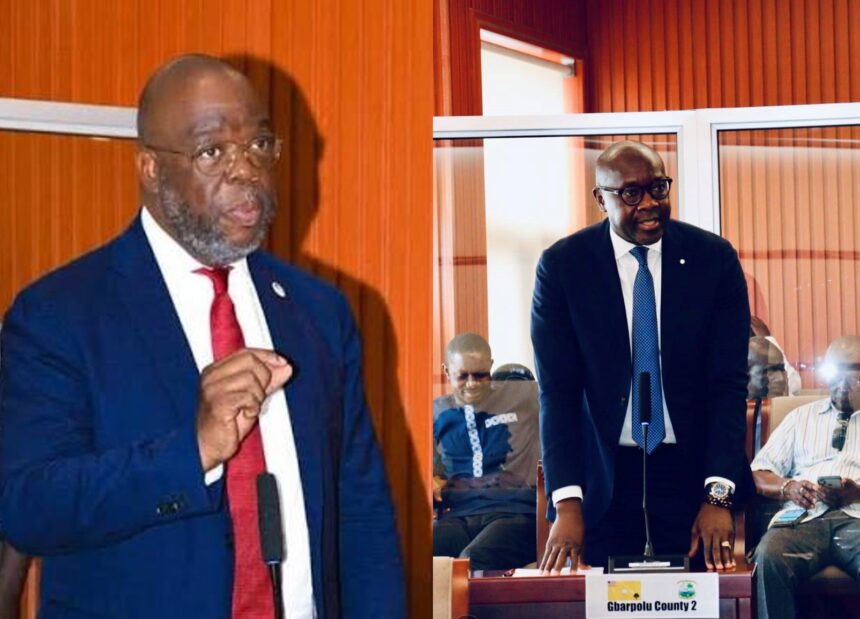
Senators Edwin Snowe of Bomi County and Amara Konneh of Gbarpolu County have been leading the bandwagon of repulsion against the move to deny TIA the opportunity to executive the agreement.
The Liberian government is pushing a new agreement with a company said to be laden with controversial identities and credentials problems instead of using the legal means to resolve the disagreement over the TIA contract.
Addressing a series of concerns around the on-going attempts against the TIA Agreement, Snowe argued the legal pedestals “laid down in the agreement should be utilized if any of the parties has concerns, insisting that ‘Nothing in Our Jurisprudence Allows De-ratification’”.
Senator Snowe said the Senate has rejected the de-ratification push, citing Constitutional limits and the principle of sanctity of contracts.
“The Liberian Senate said there is nothing in our jurisprudence that allows us to de-ratify a ratified agreement,” Snowe said on the OK Conversation with host Julius Jeh on Tuesday, June 30, 2026. “Once ratified, it carries Constitutional protection.”
Snowe argued that while the Legislature has oversight authority, it cannot unilaterally undo agreements already ratified. Doing so, he warned, “would set a dangerous precedent for contract stability in Liberia”.
The senator pointed to what he called recurring inconsistencies in government’s legal interpretations of concession agreements. He cited contradictory opinions from the Ministry of Justice on the TIA deal and concerns raised about how the agreement passed through the Public Procurement and Concessions Commission (PPCC), including the issuance and later contestation of a letter of no objection.
“At one point, the opinion from the Ministry of Justice said it was wrong. Then another opinion came and said it was right. Then another came again,” Snowe said. “When we personalize things and make them look like, for Julius it is prohibited, but for Edwin Snowe it is right, then we have a problem.”
He recalled the Senate’s past scrutiny of other concessions like MedTech, CTN, and Western Cluster over procurement and revenue concerns, saying the TIA dispute reflects a broader governance problem.
Snowe acknowledged the Executive’s concerns about how the TIA agreement was executed but said grievances must be addressed through legal channels, not political directives.
“If you are not comfortable with a legal document, there are procedures under the law to address it,” he said. “Call the parties, use the clauses in the contract, or go to arbitration. But to just say de-ratify it, that is not something we have done before.”
He noted that nominee for economic advisor Molly Kamara impressed the Senate during a recent hearing but declined to answer a direct question on TIA, which Snowe said shows how sensitive the issue is within government.
Senator Snowe has warned that shifting legal interpretations and institutional contradictions risk creating uncertainty for investors. He maintained that respect for institutions and the rule of law must come before political disagreements.
“One of his lines was that the concern of foreign investors coming to Liberia is respect for the rule of law,” Snowe said. “You may not like someone, but you must respect the office. I didn’t vote for the President, but that doesn’t mean I should not respect the presidency.”
The TIA dispute continues to generate debate between branches of government. Analysts say the outcome will test Liberia’s commitment to contract enforcement and its ability to maintain a stable environment for foreign investment.