

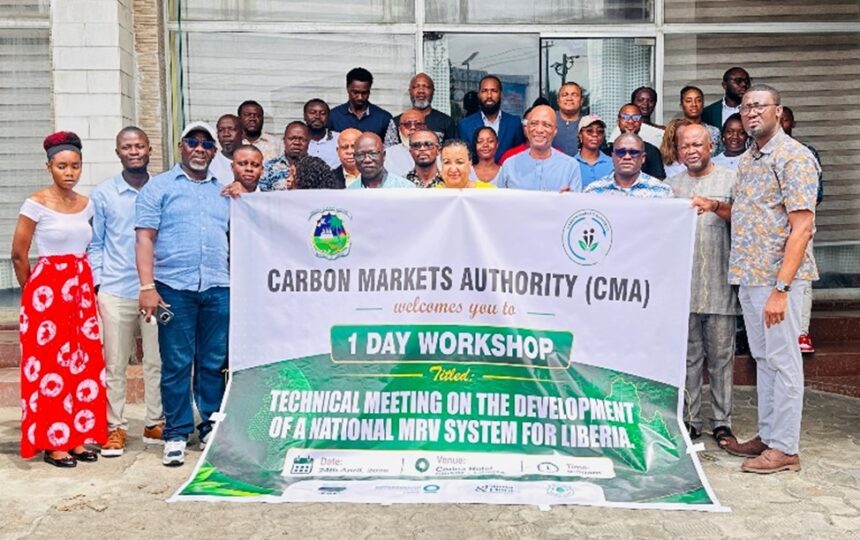
The Carbon Markets Authority (CMA) has taken a major step towards establishing a unified national carbon market system by convening a one-day technical workshop to develop Liberia’s Measurement, Reporting, and Verification (MRV) framework. Held on April 24, 2026, at the Corina Hotel, the meeting brought together stakeholders from government institutions, development partners, and the private sector to strengthen coordination and harmonize nationwide carbon-related data systems.
The workshop’s overall objective was to initiate the development of a coordinated and harmonized National MRV System by identifying existing MRV tools, systems, and datasets across sectors; promoting interoperability and data sharing among institutions; and laying the groundwork for a unified One-Government Approach to environmental reporting and carbon governance.
In her opening remarks, Jeanine Cooper, Liberia’s Special Envoy for Climate Action and Chief Executive Officer of the Carbon Markets Authority, described the workshop as a foundational moment for Liberia’s environmental governance architecture. Drawing parallels with humanitarian coordination models, including who does what, where, and when, Cooper emphasized that effective climate governance begins with credible, coordinated information systems.
She explained that the workshop seeks to consolidate fragmented environmental datasets, map institutional responsibilities, and establish a single, traceable, and bankable national system that supports carbon trading and meets international verification standards. According to her, a robust MRV system is essential for countries seeking to participate in global carbon markets and to comply with international climate frameworks.
Cooper further noted that traditional methods of environmental monitoring, including field-based forest inventories, have become increasingly insufficient due to their slow, resource-intensive nature. She emphasized that emerging digital and satellite technologies now provide opportunities for real-time, high-resolution environmental monitoring that can significantly improve accuracy, transparency, and scale.
Also speaking at the workshop, Environmental Protection Agency Chief Technical Advisor, Ben Karmouh, reflected on previous national efforts to strengthen climate and environmental expertise. He pledged the EPA’s full support for the Carbon Markets Authority’s initiative, noting that the proposed MRV framework would improve the acquisition and accessibility of national data for stakeholders.
For his part, Deputy Minister for Planning and Development at the Ministry of Agriculture, David K. Akoi, highlighted the urgent need for technical capacity building to address existing knowledge gaps among practitioners tasked with implementing MRV systems across sectors.
The Country Director of Conservation International in Liberia, Momodu Michael Kemokai, reaffirmed his institution’s support for the initiative and disclosed that Conservation International has already established a natural capital accounting scheme intended to help Liberia derive sustainable value from its environmental resources.
Meanwhile, Technical Advisor at the Forestry Development Authority, Augustine B. M. Johnson, urged stakeholders to build on lessons learned from previous data collection methods while embracing innovative technologies that can respond to the rapidly evolving demands of the carbon and forestry sectors.
Liberia’s proposed national carbon market framework will consist of three core components: a Measurement, Reporting, and Verification (MRV) System for data collection and validation of greenhouse gas (GhG) emissions; a National Carbon Registry to manage carbon assets and transactions; and an integrated national data platform to enable secure data exchange, storage, and analytics among participating institutions.