
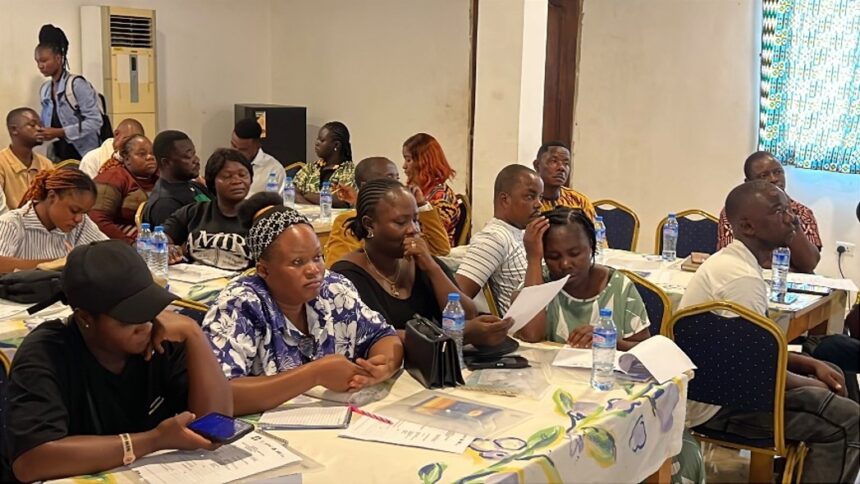
The Liberia Intellectual Property Office and the United Nations Industrial Development Organization are conducting a four-day training for 30 business owners in Bong County on intellectual property protection, financial management and enterprise development.
The training, which runs from June 8–11, is the Bong County leg of the Business and Intellectual Property Management Clinic (BIPMC) project, following its inaugural run in Lofa County last week. The Clinic is a joint initiative by LIPO and UNIDO, through its GROW-2 project, targeting 100 micro, small and medium-sized enterprises in four counties, Lofa, Bong, Nimba and Margibi, with the goal of protecting and commercializing their intellectual property assets while also improving their overall business management, financial readiness and market competitiveness.
The four-day clinic equips participants with practical tools in intellectual property identification, trademark registration, branding, financial literacy and enterprise planning. The initiative primarily targets businesses operating in agriculture, agro-processing and related value chains.
In remarks at the opening on June 8, LIPO Deputy Director General for Industrial Property, Jamus P. Bannah, said the Bong County clinic builds on the early momentum from Lofa and reflects a deliberate strategy of reaching entrepreneurs beyond the capital.
“Intellectual property is not a concept reserved for large corporations or urban centres,” Bannah said in a joint press release. “The businesses here in Bong County, their product names, their processing methods and their packaging ideas, are assets that need to be protected. Our job is to help them see that, protect them and put them to work.”
According to Bannah, the county-level rollout of BIPMC is intended to deliver LIPO services directly to entrepreneurs where they operate, reducing barriers that have historically limited access to intellectual property registration and business development support outside Monrovia.
Also speaking, Dave Asa Newton, Senior National Value Chain Expert for UNIDO GROW-2, noted that the clinic addresses a persistent gap in Liberia’s MSME landscape: the disconnect between business viability, visibility and business formalization.
“Most of the businesses we work with here are viable. They have real products, loyal customers and genuine potential,” Newton said. “What constrains them is the absence of systems: no financial records, no registered brands and no understanding that what they have built can actually be protected and leveraged for growth.”
Newton further said that the training’s combination of business management and intellectual property education gives participants an opportunity to strengthen both their products and the systems used to operate their enterprises. According to Newton, because of the training, the 30 business owners are learning how to protect what they create while also improving how they manage, price, promote and sell their products.
In a related development, Alford Wiggins, LIPO’s Program Manager, noted that the Lofa leg of the clinic ended with all 30 businesses filing applications for trademark protection after identifying their intellectual property assets and distinguishing among the different forms of protection.
The shift, Wiggins noted, came against the background of participants having little previous exposure to intellectual property concepts.
“By the end of the training, all 30 participants had completed the trademark application forms, with logos attached. While the applications are great news, as they mark the beginning of the registration process, they do not constitute completed registrations. Rather, they represent a key procedural hurdle that these businesses have completed.”
“Prior to the clinic, only one participant held an unregistered trademark, and only one possessed a logo. The result represents an important step because the businesses moved from having limited knowledge of intellectual property to completing and submitting their applications for trademark protection.”
According to Wiggins, at the start of the Lofa clinic, only three of the 30 participants had prior exposure to business management concepts, particularly bookkeeping, costing, budgeting, financial management and business formalization. Wiggins added that the Lofa results confirmed that most county-level businesses continue to operate without formal business training, which hinders their growth.
“The good news is that the practical exercise conducted at the end of the clinic showed improved understanding of business management concepts among participants. This is exactly what this Clinic is designed to change.”
Meanwhile, the initiative is expected to continue in Nimba and Margibi counties in the coming weeks, following the Bong County leg, with more than 50 businesses expected to participate across the two counties.