
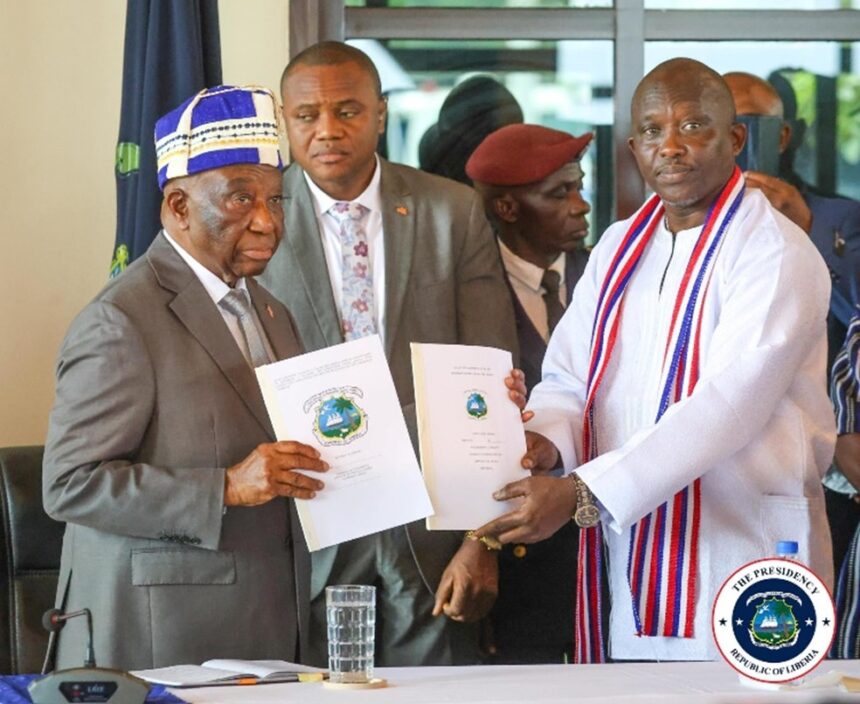
The Government of Liberia (GOL) has earmarked US$2 million each fiscal year to establish the long-delayed War and Economic Crimes Court, marking the Boakai administration’s most concrete step yet toward prosecuting atrocities from the nation’s 14-year civil war. The funding, announced Tuesday, May 5, 2026, will sit as a grant under the Ministry of Justice while the court’s office functions as a semi-independent entity tasked with laying the groundwork for trials.
Deputy Information Minister, Daniel O. Sando, told reporters at the Ministry of Information that the US$2 million will be released in four quarterly tranches of $500,000. To ensure oversight, the WECC office must file quarterly operational and financial reports to the President through the Minister of Justice. The structure is designed to balance autonomy with accountability as the office navigates the politically sensitive process of setting up the tribunal.
President Joseph N. Boakai has ordered the team responsible for establishing the court to deliver a detailed 60-day roadmap. That plan must outline how the office will mobilize additional resources, identify international and domestic funding partners, and conduct broad stakeholder engagement. The directive signals that the US$2 million allocation is seed money, not the full budget, and that success will depend on building a coalition of donors and civic actors.
The push to create the court fulfills a core recommendation of the Truth and Reconciliation Commission, which documented widespread atrocities during Liberia’s civil conflict from 1989 to 2003. An estimated 250,000 people were killed, and the war left enduring social and economic wounds. The TRC called for a special tribunal to try those bearing the greatest responsibility for war crimes and economic crimes, but successive administrations failed to act on the recommendation.
For victims and families who have waited decades for legal redress, the Boakai administration’s move represents a break from years of delay. By placing money behind the promise and demanding a rapid implementation plan, the government is signaling that accountability is no longer theoretical. Still, the court faces steep hurdles: securing judges, protecting witnesses, navigating political resistance, and raising funds well beyond the initial $2 million.
The WECC office now has two months to show how it will turn the allocation into a functioning court. If it succeeds, Liberia would join a small group of nations that have moved from truth commissions to criminal trials for civil-war-era crimes. If it stalls, the $2 million risks becoming another line item in a long history of unfulfilled justice.